Ruby On Rails
12 min

Three months sounds like plenty of time until you start building software. Deadlines compress, feature lists expand, and suddenly "90 days" feels like a mirage. But for a well-structured rails development team, that window is enough to ship real, production-ready value.
This article breaks down exactly what a dedicated Ruby on Rails development team can deliver in 90 days, week by week, with realistic scopes, concrete milestones, and honest trade-offs. Whether you are planning mvp development for a new SaaS product, modernizing a legacy application, or launching an internal tool, this is the practical guide to setting expectations and hitting them.
Answering the 90-Day Question Upfront
A focused rails development team working full-time over 12 to 13 weeks can ship a production-ready MVP, a modernized core module, or a targeted performance refactor. "Production-ready" means real users can sign up, complete core workflows, and the application runs on monitored infrastructure with documentation. It does not mean every feature on your wish list makes it in.
At Essence Solusoft, a dedicated ruby on rails development team typically structures a 90-day engagement around four concrete milestones. By the end of week 2, stakeholders see a clickable prototype validating the core idea. By week 6, core features are functional in a staging environment. By week 10, integrations and hardening are complete. By week 12 or 13, the application is deployed to production with monitoring, basic documentation, and a post-launch feedback cycle underway.
Here are three specific outcomes that are realistic within this window:
B2B SaaS MVP: User signup, onboarding flow, core business module (data management, workflow automation), role-based access, simple billing integration, and an admin console. Deployed and usable by first customers.
Internal admin or dashboard tool: Authentication, roles and permissions, data CRUD screens, CSV import/export, webhook integration to an external system, reporting dashboard. Ready for internal teams to use daily.
Rails version upgrade: Upgrading a Rails 5.2 application to Rails 7.x, updating Ruby versions, replacing deprecated gems, improving test coverage, and resolving security warnings. Industry case studies show similar upgrades completed in as few as six weeks, resulting in roughly 40% faster page loads and zero production incidents post-launch.
The most important expectation to set upfront: scope focus wins. In 90 days, feature creep is toxic. It is far more valuable to have a lean set of features done, tested, and in production than an oversized backlog with half-finished work. Essence Solusoft's approach treats scope discipline as a core competency, not an afterthought.
What a Rails Development Team Looks Like in Practice
A typical ruby on rails development team at Essence Solusoft includes one technical lead or senior Rails engineer, two to four rails developers, a quality assurance engineer, a part-time UX/UI designer, and DevOps support (often shared or engaged as needed). A typical Ruby on Rails team also features a product manager who coordinates priorities and stakeholder communication. Ruby on Rails development teams typically consist of backend and frontend roles working in coordination.
Here is how responsibilities break down:
Role | Primary Responsibilities |
Tech Lead | System architecture, design decisions, code review oversight, risk assessment |
Rails Developers | Feature development, models, controllers, views, business logic, API endpoints |
QA Engineer | Test strategy, automated test suites, exploratory testing, regression checks |
UX/UI Designer | Wireframes, prototypes, usability testing, visual design |
DevOps | CI/CD pipelines, staging/production environments, monitoring, deployments |
Project Manager | Sprint planning, stakeholder communication, scope management |
Front-end developers implement user interfaces using HTML, CSS, and JavaScript, while backend ruby on rails developers manage databases using Active Record and create APIs. DevOps engineers manage deployments and continuous integration pipelines for Rails applications.
A dedicated team outperforms scattered freelancers for 90-day delivery. Cohesion matters. A team that shares conventions, understands the codebase, and communicates daily reduces context-switching, catches issues faster, and ships more consistently. Freelancers, especially distributed ones, often produce mismatched quality and inconsistent architectural decisions.
Small Rails startups often combine multiple roles to optimize for versatility compared to larger teams that specialize. At Essence Solusoft, Rails developers often function as full-stack engineers, handling backend Rails, frontend views (or React/Hotwire), and basic cloud deployment. This keeps hand-offs low, decisions fast, and the team lean enough to move at the pace a 90-day window demands. Team members should actively participate in both development and operations to foster a culture of ownership.
Rails in 90 Days: Typical Deliverables You Can Expect
Not every project looks the same, but these deliverable types consistently fit inside a 90-day timeline with a dedicated development team:
SaaS MVP - Customer portal, core workflow module, subscription billing, role-based access, admin console.
Internal dashboard or admin tool - Data CRUD, filters, import/export, notifications, audit logging, reporting dashboard.
Customer-facing portal - Authentication, user profiles, self-service features, support ticket submission, account management.
Small e-commerce application - Product catalog, cart, checkout, payment integration, order management. Ruby on Rails can handle high-traffic e-commerce sites with the right architecture.
API backend - RESTful endpoints for mobile or third-party consumers, webhook support, authentication tokens, API documentation.
Legacy module modernization - Upgrading a specific portion of an older rails application, replacing deprecated components, improving test coverage.
For each of these, "finished" means more than code that runs locally. It means authentication and user accounts are working (signup, login, password reset), basic roles are enforced, core user flows are end-to-end functional, an admin management area exists, and essential analytics or logging are in place.
Ruby on Rails emphasizes convention over configuration to improve development speed and reduce onboarding time. The rails framework provides built-in components like scaffolding, Active Record for database modeling, and Action Mailer for emails. These conventions reduce boilerplate and let the team focus on business logic instead of reinventing infrastructure.
Ruby on Rails applications can leverage a variety of technologies such as React and Angular for enhanced functionality on the frontend. The rails ecosystem is mature enough that most common needs already have battle-tested solutions.
Essence Solusoft focuses on production-ready outcomes. That means deployment to real infrastructure, monitoring and error tracking, documentation (README, API docs, runbooks), and a CI/CD pipeline. Not demo-ware. Not "it works on my machine."
The First 2 Weeks: Discovery, Architecture, and Rapid Prototyping
The first 10 to 14 days determine whether the remaining 76 days succeed or struggle. Ambiguity now costs exponentially later. This phase is about alignment, clarity, and laying an architectural foundation that will not need to be torn down mid-project.
Key activities during this window include:
Stakeholder workshops to clarify business needs, user personas, success metrics, and core workflows. These sessions determine what "done" looks like.
Codebase audit (if existing code is present) to evaluate code quality, test coverage, dependency health, and Rails/Ruby version status.
Architecture definition around the rails framework: Rails version, Ruby version, database choice, JavaScript approach (Hotwire, React, or vanilla), background job system, and hosting plan.
Data modeling with an initial entity-relationship diagram. Rails teams benefit from clear guidelines for code architecture and database design from the start.
Rapid prototyping of the core user interaction. This could be a Figma prototype or a simple coded Rails skeleton with basic models, a few screens, and seed data. The goal is to validate the primary user flow and catch UX problems early.
Concrete outputs at the end of week 2: a prioritized backlog, signed scope for the first release, a high-level ERD diagram, a deployment plan, and a clickable prototype or proof-of-concept that stakeholders can react to. This is where managing a Ruby on Rails development team requires balancing agile workflows and technical standards from day one.
Weeks 3–6: Core Feature Development with Ruby on Rails
This is the core shipping engine of the 90-day window. The prototype becomes a working product. The backlog becomes deployed features. These four weeks account for the majority of product value delivered.
Typical features implemented during this phase:
User registration, login, and password recovery
Roles and permissions (admin vs. standard user, or more granular)
Primary CRUD flows (the core value-delivering interactions)
Email notifications for key events
Payments or subscriptions, if integral to the business model
Basic API endpoints for external consumption
Rails expertise shines here. Active Record handles associations, validations, and query building. RESTful controllers follow conventions that any Rails developer can read and extend. Service objects encapsulate complex business logic, keeping controllers thin and models focused.
A typical sprint structure looks like this:
Sprint | Duration | Focus |
Sprint 1 | Weeks 3–4 | User auth, primary data models, first CRUD flows |
Sprint 2 | Weeks 5–6 | Remaining core features, notifications, admin views |
At the end of each sprint, Essence Solusoft deploys to staging and holds a demo with stakeholders. This cadence ensures the roadmap stays aligned, catches misinterpretations early, and prevents surprises in week 11. Progress is visible, not just reported.
Ruby on Rails enables rapid application development during this phase. The framework's generators, conventions, and mature gem ecosystem mean less time on boilerplate and more time on the features that differentiate your product.
Weeks 7–10: Hardening, Integrations, and UX Polish
Core features are built. Now the application needs to be robust enough for real users who will do unexpected things, use slow connections, and trigger edge cases your team has not considered yet.
Typical work in this window:
Third-party integrations: Connecting to payment processors, messaging APIs, CRM development endpoints, or external data sources. Rails supports building APIs and third-party integrations cleanly through its controller and service layer patterns.
Database query optimization: Refining slow queries, adding missing indexes, eliminating N+1 patterns.
Background jobs: Moving email delivery, report generation, and external API calls to asynchronous processing. Rails supports performance optimization through caching and background jobs via Active Job and Sidekiq.
Error handling: Graceful failure states, user-facing error messages, retry logic for external services.
UI/UX refinement: Responsive layouts, loading states, accessibility improvements, polish on primary user flows.
Rails services like Action Mailer (email), Active Job (background processing), and built-in caching (fragment, page, low-level) make this work efficient. These are not add-ons; they are part of the rails framework, ready to use with minimal configuration.
Quality assurance engineers ensure software stability through testing and writing automated test suites. During weeks 7 through 10, automated test coverage grows significantly. The QA engineer runs manual exploratory testing on edge cases, performance checks on critical endpoints, and regression testing against previously shipped features. Rails development includes comprehensive testing and quality assurance as a fundamental practice, not a last-minute afterthought.
Weeks 11–13: Launch, Feedback, and Iteration
"90 days" does not end with a code freeze. It includes the first production push plus at least one feedback-driven iteration cycle.
Deployment in a Rails context involves configuring production environments, running database migrations and seeds, setting up CI/CD pipelines, establishing monitoring and logging (error tracking, performance instrumentation), and defining rollback strategies. Rails applications can be deployed with smooth transitions when this groundwork is laid properly.
After launch, Essence Solusoft gathers early user feedback through multiple channels:
Analytics events on critical user flows (signup completion, core feature usage, drop-off points)
Direct user interviews or structured feedback sessions
Support tickets and bug reports
A short iteration cycle (one to two sprints) addresses the top usability issues, critical bugs, and performance friction identified from real usage. This is not scope expansion; it is scope refinement based on evidence.
The final deliverable of the 90-day engagement is not just a deployed application. It also includes a small but meaningful post-launch roadmap: what should be built next, what technical debt needs attention, what performance issues surfaced under real load, and what features were intentionally deferred. This roadmap becomes the starting point for the next phase, whether with the same team or an internal one.
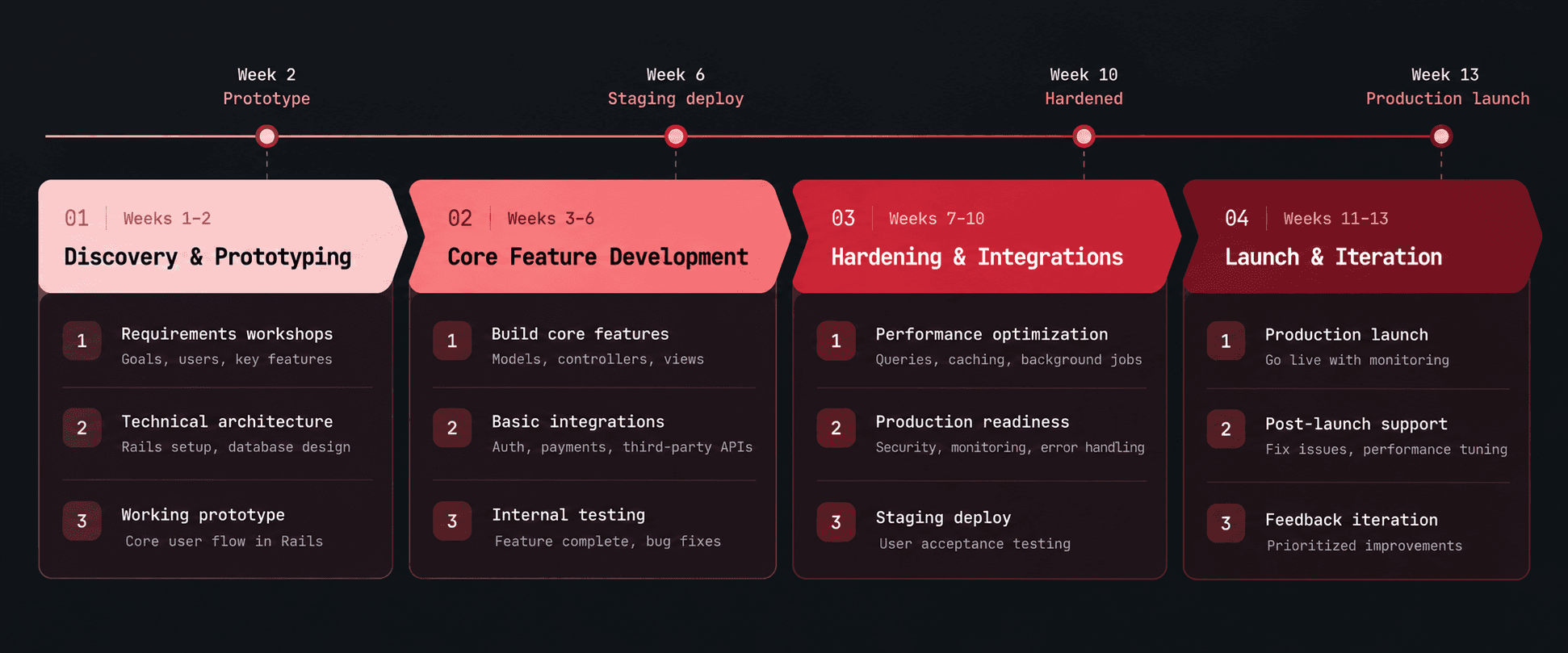
90-Day Ruby on Rails MVPs: Realistic Scopes by Product Type
Not every MVP is the same. Here is what fits comfortably into 90 days for four common product types, and what should wait.
B2B SaaS Dashboard
In scope: User accounts, login, roles (admin and standard), core data workflows (e.g., upload and process), dashboard with key metrics, admin panel for user and customer management.
Deferred: Complex analytics, multi-tenant architecture, advanced permission hierarchies, heavy external integrations.
Two-Sided Marketplace
In scope: Buyer and seller profiles, product listings, search and filter, checkout with payment integration, basic messaging, seller dashboard.
Deferred: Dynamic pricing algorithms, full ratings and review systems, native mobile apps, ML-driven recommendations.
Content-Driven Application
In scope: Content creation and editing, publishing workflows, user registration, content search, commenting or feedback, admin area.
Deferred: Rich media handling (video streaming), personalization engines, advanced editorial workflows, deep SEO automation.
Internal Workflow or Operations Tool
In scope: Roles and permissions, CRUD screens for core data, import/export, notifications, audit logging, operational dashboards.
Deferred: Deep reporting and analytics, integrations with many external systems, AI-assisted workflows, complex approval chains.
Essence Solusoft helps founders and product owners trim scope to match a realistic ruby on rails delivery window. The question is not "what do we want?" but "what must exist for the first users to get value?" Rails developers prioritize essentials that validate the business model: user activation signals, retention metrics, revenue paths. Everything else enters the backlog for later phases.
Over 130 industries use Ruby on Rails applications. Whether your product serves healthcare, logistics, finance, or education, the framework has been proven at scale across various industries.

Custom Software Development with Rails vs. Generic Web Development
There is a meaningful difference between custom software development built on Ruby on Rails and generic, technology-agnostic web development. Generic approaches often require more boilerplate, more architectural decisions upfront, and more time selecting and integrating disparate libraries. Rails arrives with opinions already baked in: directory structure, RESTful routing, Active Record, testing frameworks, and a convention-driven workflow that shortens the road from idea to working software.
Ruby on Rails is an open-source framework, which eliminates licensing fees and gives teams full control over their codebase. The ruby programming language is expressive and readable, reducing onboarding time for new developers joining a project.
For a 90-day timeline, predictability matters more than novelty. Custom software development services built on Rails benefit from a known stack, a mature ecosystem with thousands of gems, and a community that has battle-tested patterns for authentication, authorization, billing, search, and background processing. Essence Solusoft's focus on one strong core stack (Ruby, Ruby on Rails, supporting JS frameworks) provides the rapid development capabilities that make 90-day delivery realistic rather than aspirational.
Rails is especially well suited for CRUD-heavy business applications, SaaS platforms, admin panels, and web application development in general. When a project requires heavy real-time interaction (games, video streaming) or complex native mobile UIs, the team might complement Rails with other services. But for the majority of business software, rails web development delivers the best ratio of speed to maintainability.
How a Dedicated Rails Team De-Risks Your 3-Month Project
Time-boxed projects carry inherent risks: scope creep, unclear ownership, technical surprises in legacy code, and insufficient test coverage surfacing only at launch. A dedicated rails development team mitigates these risks through structure, not luck.
Ways Essence Solusoft lowers risk in complex projects:
Early technical spikes to validate uncertain integrations or architectural choices before committing sprint time
Clear acceptance criteria for every user story, agreed upon before development begins
Regular demos (end of each sprint) that make progress visible and catch misalignment early
Strict scope management with explicit trade-off conversations when new requests surface
Code reviews and pairing as mechanisms to keep rails projects maintainable even under deadline pressure
Good practices for Ruby on Rails teams include optimizing test suites and conducting code reviews. These are not optional extras in a 90-day window; they are what prevent small mistakes from compounding into launch-blocking problems.
Transparency is equally important. Essence Solusoft communicates what cannot reasonably be shipped in 90 days, not just what can. There is no overpromising. Clear statements about scope limitations, deferred features, and known trade-offs build trust and set the project up for sustainable continuation.
Rails Services That Fit Inside a 90-Day Window
Several distinct rails services can be fully or substantially delivered within a 90-day engagement:
MVP build - Discovery through production deployment for a new product. Phase one typically includes core user flows, authentication, admin panel, and monitoring.
Limited legacy modernization - Refactoring a critical module, replacing deprecated components, improving test coverage on high-risk areas of a rails application.
Rails version upgrade - Upgrading from an older version (e.g., Rails 5.2 to 7.x) for a single application, including Ruby version bump, gem updates, and compatibility fixes.
Performance optimization - Identifying and resolving bottlenecks: slow queries, missing indexes, absent caching, synchronous operations that should be async. Essence Solusoft's teams handle performance optimization as a focused engagement with measurable before-and-after metrics.
Security hardening - Dependency audit, patching vulnerabilities, adding two-factor authentication, reviewing authorization logic, implementing audit logging.
API development - Building RESTful or GraphQL endpoints for mobile clients or third-party consumers, with documentation and test coverage.
Essence Solusoft shapes engagements to deliver one main outcome rather than many half-finished initiatives. A 90-day window works when the goal is clear: "get the SaaS MVP live" or "upgrade to Rails 7 safely" or "cut response times on critical endpoints by 50%." Trying to do all three dilutes everything.
These rails development services connect directly to ongoing support and long term maintenance. The 90-day deliverable is designed to be continued, not abandoned.
Rails Upgrades, Modernization, and Technical Debt in 90 Days
Many organizations run Rails applications stuck on older versions: Rails 4 or 5, outdated Ruby versions, unmaintained gems with known security vulnerabilities, deprecated APIs like the classic autoloader or old asset pipeline, and mixed frontend technologies (CoffeeScript, jQuery). These cause security exposure, performance degradation, and increasing difficulty hiring developers willing to work on outdated stacks.
Rails applications can be upgraded to newer versions. Ruby on Rails supports legacy application modernization as a first-class concern. Rails applications benefit from regular upgrades and careful management of dependencies.
A 90-day modernization push can realistically accomplish:
Bumping Rails across one or more major versions using incremental upgrade steps
Updating Ruby to a current, supported version
Replacing or updating outdated gems
Removing deprecated features (asset pipeline transitions, autoloading changes)
Cleaning up critical areas of technical debt (performance hotspots, oversized controllers, missing test coverage in key flows)
Essence Solusoft takes a staged, incremental approach to upgrades. This outperforms "big bang" rewrites: version-by-version upgrades preserve production stability and allow teams to catch issues at each step. For example, a legacy B2B platform running Rails 5.2 with Ruby 2.5 was stabilized and upgraded to Rails 7.1 with Ruby 3.2 in under three months. The result was roughly 40% faster page loads, elimination of known security vulnerabilities, and significantly reduced ongoing maintenance overhead.
Performance and Scalability Work a Rails Team Can Ship Quickly
Performance optimization fits naturally into a 60 to 90-day rails engagement because many gains come from non-feature work. Once you understand the codebase, the fixes are often predictable: query optimization, index tuning, caching, background job introduction.
Typical performance tuning activities:
Eliminating N+1 queries using eager loading or query restructuring
Adding missing database indexes on frequently queried columns
Introducing fragment caching, HTTP caching, or low-level Rails caching
Moving report generation, email delivery, and external API calls to background jobs
Optimizing view rendering and asset delivery
Profiling with Rails' built-in logging and diagnostic tools
Realistic targets might include bringing a slow report endpoint from 30 seconds to under 3 seconds, reducing server CPU and memory usage by 30 to 50 percent, or improving time-to-first-byte by 20 to 40 percent. These are achievable without exaggeration, based on common optimization patterns.
Rails applications can scale seamlessly as user demands increase. Ruby on Rails can handle growth efficiently with modular architecture, and Rails applications can maintain performance during high-traffic periods when properly optimized. These scalability gains extend well beyond the initial 90-day engagement, supporting future user growth.
Rails Developers and AI Development in the First 90 Days
AI-powered features are increasingly expected in modern web applications, and ruby on rails teams can integrate them pragmatically within a 90-day window. The key word is "pragmatically." This is not about training custom models; it is about connecting to proven AI APIs and wrapping them in a usable, testable Rails interface.
Common 90-day ai development integrations include:
Content suggestions or auto-completion using external language model APIs
Simple classification (e.g., categorizing support tickets, tagging documents)
Smart search via embeddings
Text summarization for long-form content
Basic AI assistants scoped to specific workflows
The typical implementation pattern involves using gems like ruby-openai to call external models, building Rails controllers and endpoints to handle AI requests and responses, storing results for review, and adding basic feedback loops so users can correct or approve AI outputs. Machine learning capabilities are accessed through external services rather than built from scratch, which keeps scope manageable.
Essence Solusoft focuses on safe, auditable, and testable AI integration rather than black-box magic. AI features add dependencies, latency, and potential unpredictability. Only minimal, well-scoped features should be included in the first release. Computer vision, deep learning pipelines, or complex machine learning model training are better suited to dedicated ai development engagements with specialized teams.
A practical example: an AI-assisted support ticket classifier built on top of an existing Rails admin UI. Incoming tickets are automatically categorized by priority and topic, with human review before action. The feature adds value immediately while remaining auditable and easy to override.
Mobile and Web: When Rails Powers Both in 90 Days
Ruby on Rails frequently serves as the API backend for mobile app development while simultaneously delivering a responsive web application. This dual-use architecture is one of Rails' strengths.
Realistic 90-day outcomes include a stable Rails API powering iOS or Android clients (built by a separate mobile team) alongside a basic web admin console for operations teams. The API follows RESTful conventions, is documented, and includes an automated test suite that mobile developers can rely on.
Essence Solusoft collaborates with mobile teams (internal or partner vendors) using clear API contracts, versioning strategies, and shared test suites. The backend and mobile efforts can run in parallel when the API specification is defined early in the discovery phase.
An important constraint: full native apps rarely fit end-to-end in the same 90-day window as a fresh backend unless scope is very focused (one platform, few screens, simple UI). For teams that need mobile and web simultaneously, Hotwire Native offers a hybrid approach where a single Rails codebase can power both web and mobile experiences, though with trade-offs in native feel.
Security, Compliance, and Data Protection Within 3 Months
Common Rails security concerns include outdated dependencies with known vulnerabilities, missing CSRF protections, weak authentication flows, insecure file uploads, and absent audit logging. Ruby on Rails has built-in security features against common vulnerabilities, including protection against SQL injection, cross-site scripting (XSS), cross-site request forgery (CSRF), and strong parameter filtering. These security features are active by default when Rails conventions are followed correctly.
Security work that fits well into a 90-day sprint:
Dependency audit and updating gems to patched versions
Adding two-factor authentication for critical accounts
Reviewing and implementing authorization logic (using patterns like Pundit or CanCanCan)
Enforcing strong password policies and secure session management
Sanitizing inputs, validating file uploads, implementing rate limiting
Setting up logging and audit trails for sensitive actions
Basic error monitoring and threat detection
The difference between baseline hardening in 90 days and longer-term compliance work (HIPAA, SOC 2, GDPR audit) should be clear. Baseline security is achievable. Full compliance certification is a multi-month initiative that extends beyond the initial engagement.
Essence Solusoft reinforces Rails' built-in protections through code reviews, automated security tests, and linting. The goal is to ship software that is secure by default, with documented security practices that the next team can continue to enforce.
How Essence Solusoft Plans a 90-Day Rails Roadmap
Planning a rails development project starts weeks before the first line of production code is written. Essence Solusoft follows a structured approach:
Discovery workshops with stakeholders to define business goals, user personas, core workflows, and success metrics
Estimation and risk analysis to identify dependencies, external API uncertainties, and technical unknowns
Milestone definition with clear acceptance criteria for each deliverable
Trade-off decisions documented and signed off by the client's product owner
Here is what a typical 90-day roadmap looks like:
Milestone | Timeframe | Acceptance Criteria |
Milestone 1: Foundation | End of Week 2 | Signed scope document, tech stack chosen, prototype built, backlog prioritized |
Milestone 2: Core Build | End of Week 6–8 | Core features implemented, staging deployment live, admin panel functional |
Milestone 3: Hardening | End of Week 10 | Third-party integrations complete, performance optimized, security reviewed |
Milestone 4: Launch | End of Week 12–13 | Production deployment, monitoring active, feedback iteration complete, post-launch roadmap drafted |
Collaborative planning with the client's product owner is essential. Trade-off decisions (features vs. robustness, scope vs. schedule) must be explicit. Effective Ruby on Rails teams prioritize communication and cross-functional collaboration among roles. When a feature request threatens the timeline, the project manager facilitates a conversation about what to defer, not whether to extend.
The roadmap aligns with measurable business needs and success metrics. "Ship feature X" is insufficient. "Ship feature X so that the first 50 users can complete the onboarding flow and activate their accounts" ties the work to an outcome that matters.
Rails Development Best Practices That Keep 90-Day Projects Sustainable
Speed alone is not enough. A 90-day build that produces unmaintainable code creates a liability, not an asset. The code shipped in week 6 must still be comprehensible and extendable in month 12.
Key ruby on rails best practices applied by Essence Solusoft:
Test coverage on critical paths: Automated testing and continuous integration are critical for maintaining application quality in Ruby on Rails projects. Unit tests for models and services, integration tests for core workflows, system tests for end-to-end user flows.
Service objects and concerns: Separating complex business logic from controllers and models keeps code readable and testable.
Consistent naming and style guides: Linters enforce conventions. Code reviews catch deviations. New developers can onboard quickly.
Documentation: README files, API documentation, deployment runbooks. Future you (or the next team) will be grateful.
Code reviews: Every merge request reviewed by at least one other developer. Catches bugs, spreads knowledge, maintains consistency.
Balancing quick wins with long-term code quality is a constant negotiation. Sometimes a temporary workaround is the right call, but it must be documented with a plan to revisit. Shortcuts that risk security or stability are never acceptable. Known areas of technical debt should be explicitly identified in the backlog and prioritized alongside new features.
These practices make it easier to continue feature development after the initial 90-day engagement, whether in-house or with the same development team. Rails development that follows agile methodologies and maintains code quality from day one pays dividends for years.
Collaboration, Communication, and Time Zones in Short Rails Engagements
Communication cadence directly influences what a rails development team can ship in 90 days. A brilliant team that waits three days for a product decision loses a sprint's worth of momentum.
Concrete collaboration habits that Essence Solusoft follows:
Weekly demos at the end of each sprint showing working software, not slide decks
Daily asynchronous updates through shared channels so everyone stays on the same page
Shared backlogs with real-time prioritization visible to all stakeholders
Decision logs that record important trade-offs and their rationale
Backlog refinement sessions to keep upcoming work well-defined before sprints start
Working with international clients requires deliberate alignment. Essence Solusoft, based in India and working globally, ensures overlapping working hours for synchronous communication, clear written documentation to reduce friction across time zones, and transparent communication about progress, risks, and blockers.
Fast decisions and quick feedback loops are as important as rails expertise for hitting the 3-month target. When a product owner is unavailable for decisions, the team stalls. Delays early in the project ripple downstream and compress the final weeks. Knowledge transfer happens continuously through documentation, pairing, and shared context rather than as a one-time handoff event.
How Essence Solusoft Measures Success After 90 Days
Success after 90 days is measured by outcomes, not output. Lines of code and number of commits are vanity metrics. What matters is whether the deliverable creates value.
Realistic success metrics:
Was the application deployed to production and used by real users?
How many users were onboarded, and what was their activation rate?
Did manual work decrease (for internal tools)? By how much?
What are the response times on critical endpoints compared to baseline?
What is the error rate and crash frequency?
How many security vulnerabilities remain unresolved?
Rails maintenance ensures application performance and reliability over time, not just at launch. Essence Solusoft proposes a follow-up plan based on these metrics. If user activation is low, the next cycle focuses on onboarding UX. If performance degrades under load, scalability work takes priority. If new features are the bottleneck to revenue, feature development leads.
No outcome is guaranteed. But the combination of a focused scope, a dedicated team, and a disciplined process consistently produces deployable, valuable software within the 90-day window.
Beyond 90 Days: Turning a Rails MVP into a Stable Product
The first 90 days produce a foundation, not a finished product. What comes next determines whether that foundation supports growth or crumbles under weight.
Next-phase activities typically include:
Expanding features based on user feedback and analytics
Refining UX with deeper usability testing
Adding more integrations (additional payment providers, CRM systems, analytics platforms)
Deeper analytics and reporting
Ongoing rails maintenance, ongoing support, and security monitoring
Performance scaling for growing user demands
Rails applications can scale to support growing user demands. Ruby on Rails supports seamless application scalability through modular architecture and careful engineering.
Essence Solusoft supports long-term rails application scalability, security, and performance beyond the initial engagement through ongoing maintenance and support engagements. The same team that built the application understands its architecture, its trade-offs, and its technical debt. Continuity reduces ramp-up time and preserves quality.
The first 90 days set the patterns: code conventions, deployment pipeline, testing culture, communication rhythm. These patterns either accelerate or hinder everything that follows. Position the initial engagement as the starting point of sustainable product growth, not a one-off project.
FAQs About 90-Day Ruby on Rails Development Teams
How big should my Rails team be for a 90-day MVP?
For most mvp development projects, a team of four to six dedicated people delivers the best balance of speed and communication. That typically means one tech lead, two to four ror developers, a QA engineer, and part-time UX and DevOps support. Larger teams increase communication overhead without proportional gains in output. Smaller teams may lack the throughput to cover core features, testing, and deployment within the window. Essence Solusoft, as an experienced rails development company, sizes teams based on project scope and complexity.
What if I already have partial Rails code?
Existing code can accelerate the timeline if it is well-structured, has decent test coverage, and runs on a recent Rails version. But if the codebase is heavily outdated (old Rails, deprecated gems, minimal tests), modernization may consume significant time before new feature development can begin. Essence Solusoft audits existing codebases during the discovery phase to determine whether it is faster to refactor, upgrade, or rebuild specific modules. A deep understanding of the existing architecture is essential before making that call.
Can you take over from another Rails developer mid-project?
Yes, but expect a transition period. A codebase audit, understanding the existing architecture, and establishing conventions with the new team takes time, typically one to two weeks. This transition reduces feature velocity early but is manageable with senior ror developers who have experience working across diverse Rails codebases. Essence Solusoft, as a leading ruby on rails development company, has handled mid-project transitions for clients across various industries.
What if we need to change scope halfway through?
Scope changes in a tight timebox are expensive. Every added feature displaces something else. Essence Solusoft builds in checkpoints at the end of each sprint to reassess priorities. If scope must change, the trade-off conversation is explicit: what gets dropped or deferred to make room? The product owner and project manager make these decisions together, guided by business impact rather than technical preference. Tailored solutions require discipline about what stays in and what moves out.
Ready to Plan Your Own 90-Day Rails Roadmap?
A focused ruby on rails development team can ship meaningful, production-ready software solutions in 90 days when scope is disciplined and collaboration is clear. Whether you need an MVP for a new SaaS product, a critical Rails upgrade, a performance overhaul, or custom solutions for an internal workflow, the 90-day window works when the goal is specific and the team is dedicated.
Essence Solusoft specializes in comprehensive services across the rails development lifecycle, from web application development and custom ruby software to website development, ror development services, and long-term support. With a dedicated ruby on rails team, rapid development is not about cutting corners; it is about making the right choices about what to build first.
Bring your specific ideas, constraints, and desired outcomes to an initial conversation. The more clarity you bring about your business needs, the more realistic and actionable the 90-day plan becomes. No project is too early to scope, and no question is too basic to ask.

Sachin Gevariya is a Founider and Technical Drector at Essence Solusoft. He is dedicated to making the best use of modern technologies to craft end-to-end solutions. He also has a vast knowledge of Cloud management. He loves to do coding so still doing the coding. Also, help employees for quality based solutions to clients. Always eager to learn new technology and implement for best solutions.
Reader guide
Use the links below to jump into next reading without leaving the article flow.
Blog categories
Recent posts
What Can a Ruby on Rails Development Team Actually Ship in 90 Days?
12 min
AI Integration in Rails: Adding AI Features Without Rebuilding Your Application
7 min
Rails Performance Optimization: Why Your Application Gets Slower Under Load
8 min
Rails CSV Export: Why Large Data Exports Fail and How to Build Them Properly
7 min

Similar Blogs